Bitwarden SSH Agent architecture
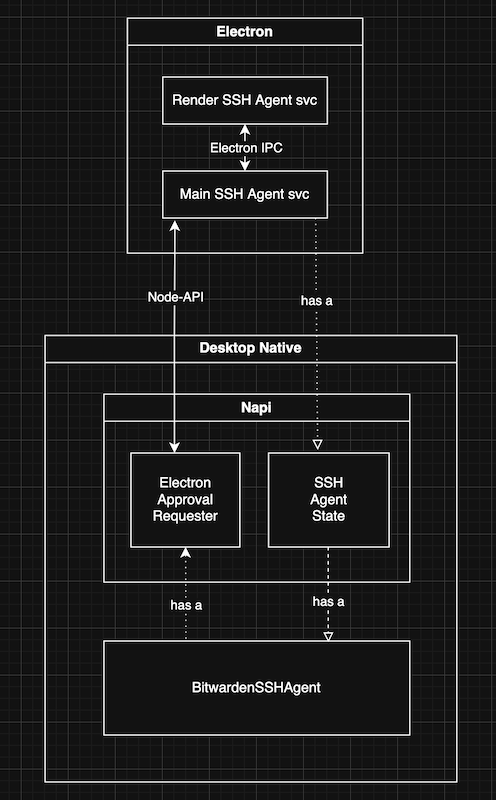
Bitwarden’s SSH Agent is primarily implemented in the Rust language, as a server that accepts ssh client connections over the SSH Agent protocol. This server interfaces with the Desktop UI through napi bindings and the Electron services.
Our agent is unique from native OS ones in that:
- true storage of keys is on a (remote) server which individual Desktop clients interface with
- users of the agent manage keys with a UI
- users of the agent (optionally) approve requests with a UI
End to end data flow
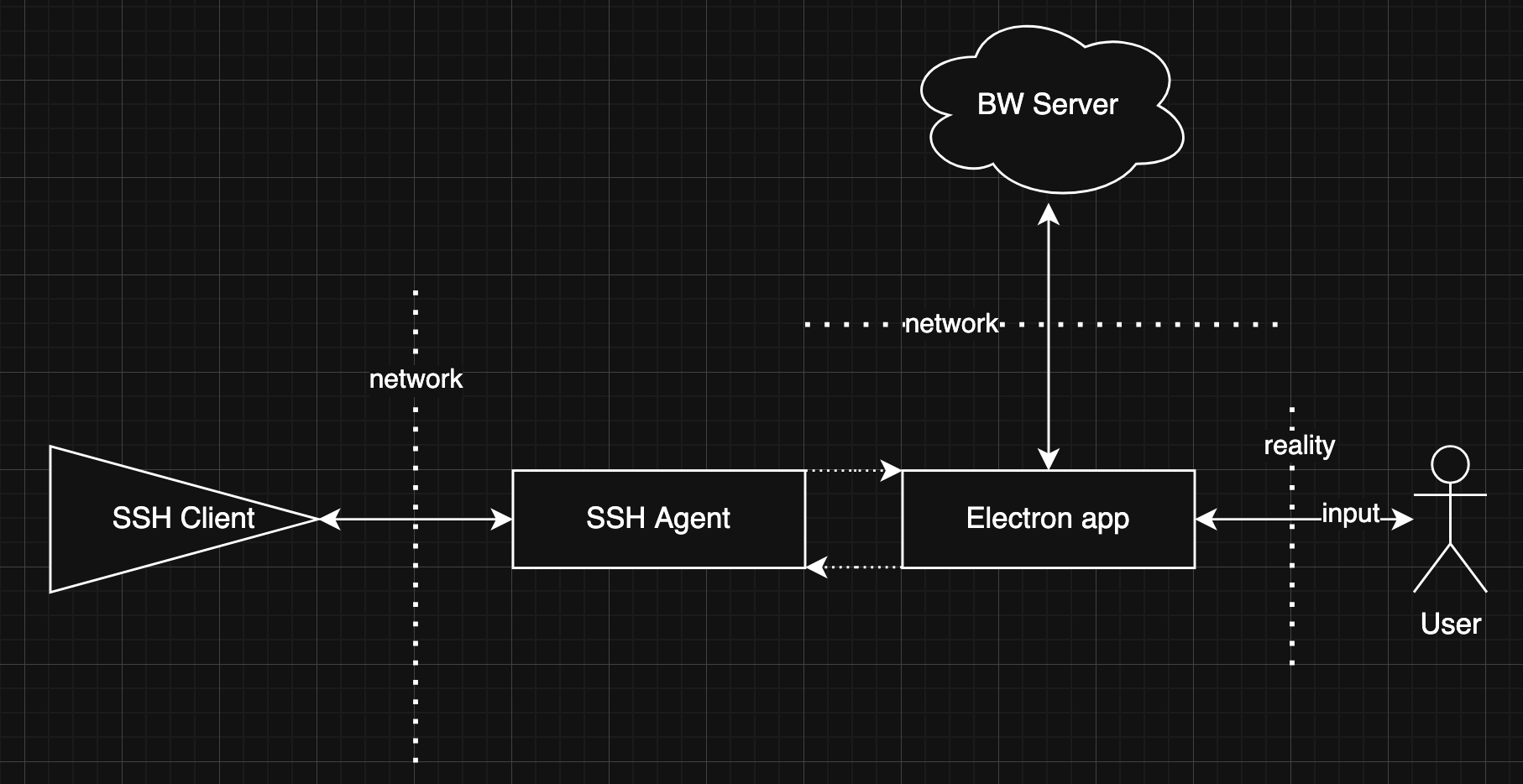
When the user enables the SSH Agent feature in user settings, the SSH key vault items are retrieved from the vault and sent to the agent. The agent server is started and it’s keystore populated with the new keys.
The Bitwarden SSH Agent server spawns a thread to handle any each new client connection. Each connection results in an async callback chain.
The Electron app replaces the keys in the agent’s keystore when there are vault changes to SSH key items.
The SSH Agent
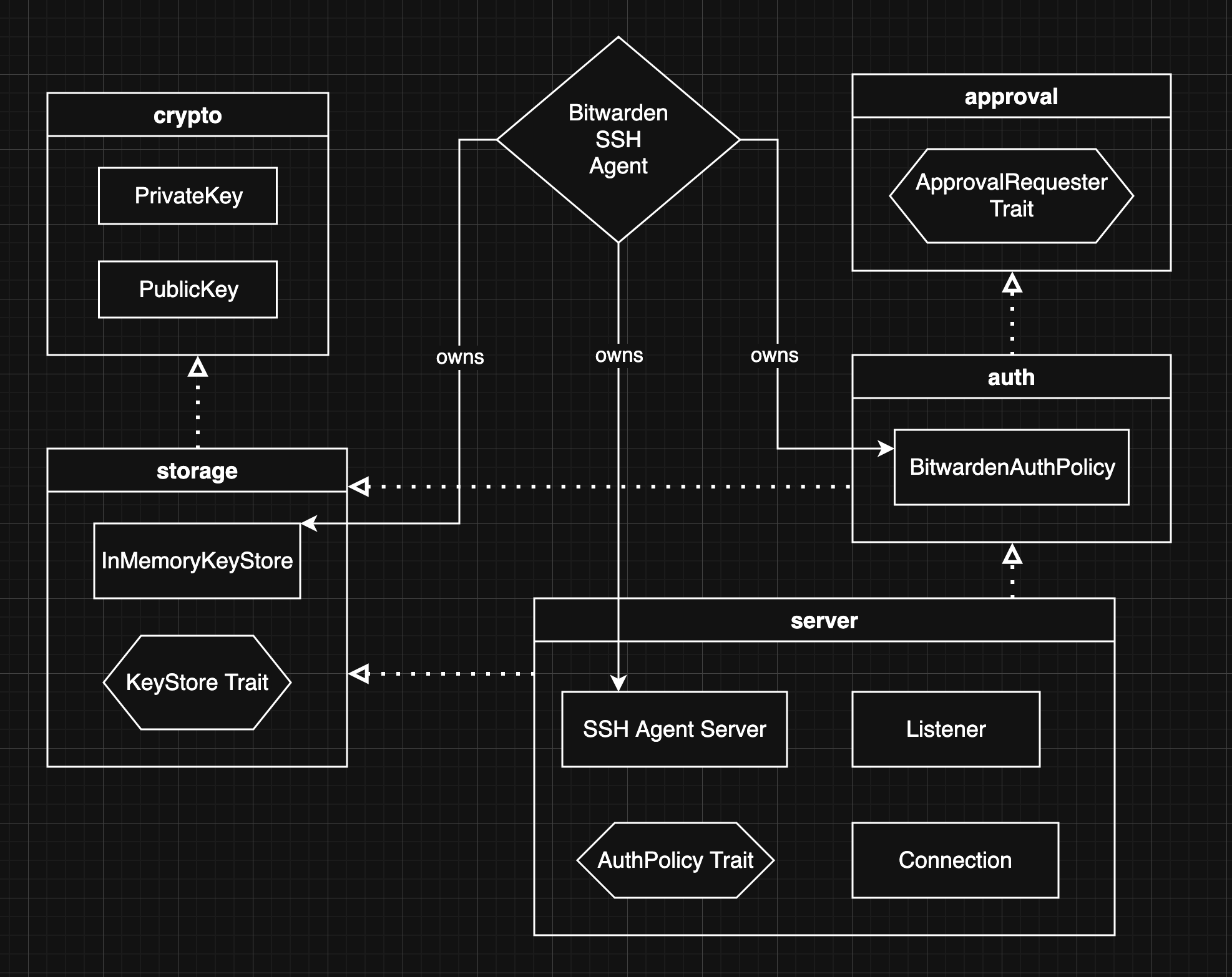
The core agent implementation itself is part of the Rust Desktop Native layer in the Desktop client. It is an almost entirely self-contained workspace crate within desktop_native.
The architecture of the agent was designed with these goals:
- efficient adherence to the SSH agent protocol spec
- clean interfaces isolating the server protocol, Bitwarden’s business logic, and user interface
- maintainability
- testability
Modules
server
Low level agent protocol implementation. It is responsible for listening for and managing new connections (clients), handling requests from connections and returning responses.
crypto
Cryptographic primitive type definitions for public and private key types that we support and handling of the signing of requests and any key-based operation.
storage
Logic that handles the storage and management of data that the agent uses, effectively the SSH keys. Currently our implementation of a key store is in-memory.
authorization
Defines the concrete policy which our agent enforces for authorization of requests. The authorization of requests is requested by the server.
approval
Interface for our agent to get approval for requests via an external entity (in our present case, Electron).
agent
The agent crate itself is a the orchestrator of all the above components. It starts and stops the server, updates the storage of keys, enforces the authorization policy, and interfaces with the external approver of requests.
Abstractions
There are two critical abstractions to understand about the agent implementation. These abstractions both serve two purposes:
-
Low coupling ; high cohesion
-
Testability
AuthPolicy
The server requests authorization for requests that it receives from client connections.
The server does not need to know about the business logic that goes into whether a request is authorized.
This interface provides an abstraction from the raw server and the agent’s business logic.
pub trait AuthPolicy: Send + Sync {
    async fn authorize(&self, request: &AuthRequest) -> Result<bool, AuthError>;
}
ApprovalRequester
The agent requests approval from an external entity, when needed based on it’s authorization policy.
The agent does not need to know about the logic or complexities of the external entity that it requests approvals through.
 pub trait ApprovalRequester: Send + Sync {
    async fn request_sign_approval(
        &self,
        request: SignApprovalRequest,
    ) -> Result<bool, ApprovalError>;

    async fn request_list_approval(&self) -> Result<bool, ApprovalError>;
}
Napi bindings
The sshagent_v2 module contains the definitions for the napi bindings which act as the bridge
between the Rust implementation of the agent, and the Electron UI.
This layer is intentionally a pass-through. There is no unique logic. A wrapper around the agent is provided to expose it to Electron.
The ElectronApprovalRequester is our concrete implementation of the ApprovalRequester trait. It simply provides a mechanism to wire-up the async callbacks that we use in the Electron services to answer the approval requests that are cascaded up from the server.
Electron services
Main service
The Main SSH Agent service is primarily a pass-through for exchanging request/response calls between Render and agent.
It maintains a request ID counter and stores the pending requests keyed by that ID.
Render service
The Render SSH Agent service is the primary business logic that interfaces between the vault data, the user interactions, and the downstream agent.
It has the following responsibilities:
- subscribes to changes in the user setting for enabling the ssh agent feature, and correspondingly starts/stops the agent.
- receives the vault ssh key items when any ssh key item is changed, and updates the agent with the new key data.
- subscribes to active account changes, and either updates the key data or stops the server depending on the new account’s state.
- receives authorization requests via the main service, and depending on the user’s setting for authorization requests, may prompt the user to authorize the request, or grant it based on cached approval, or automatically approve if authorizations aren’t configured.
Vault lock state behavior
This section describes how the agent behaves in the various vault states. For simplicity, assume only one account is active on the client and that the feature is enabled in user settings.
Logged out
The agent is not running.
Locked Before First Unlock (BFU)
The agent is running. All requests result in a toast prompt to unlock the vault.
Locked After First Unlock (AFU)
The agent is running. List requests are supported. Sign requests are supported- if authorization is required based on user setting, user is prompted to unlock their vault first, then prompted to approve the request.
Unlocked
The agent is running, all functionality supported.